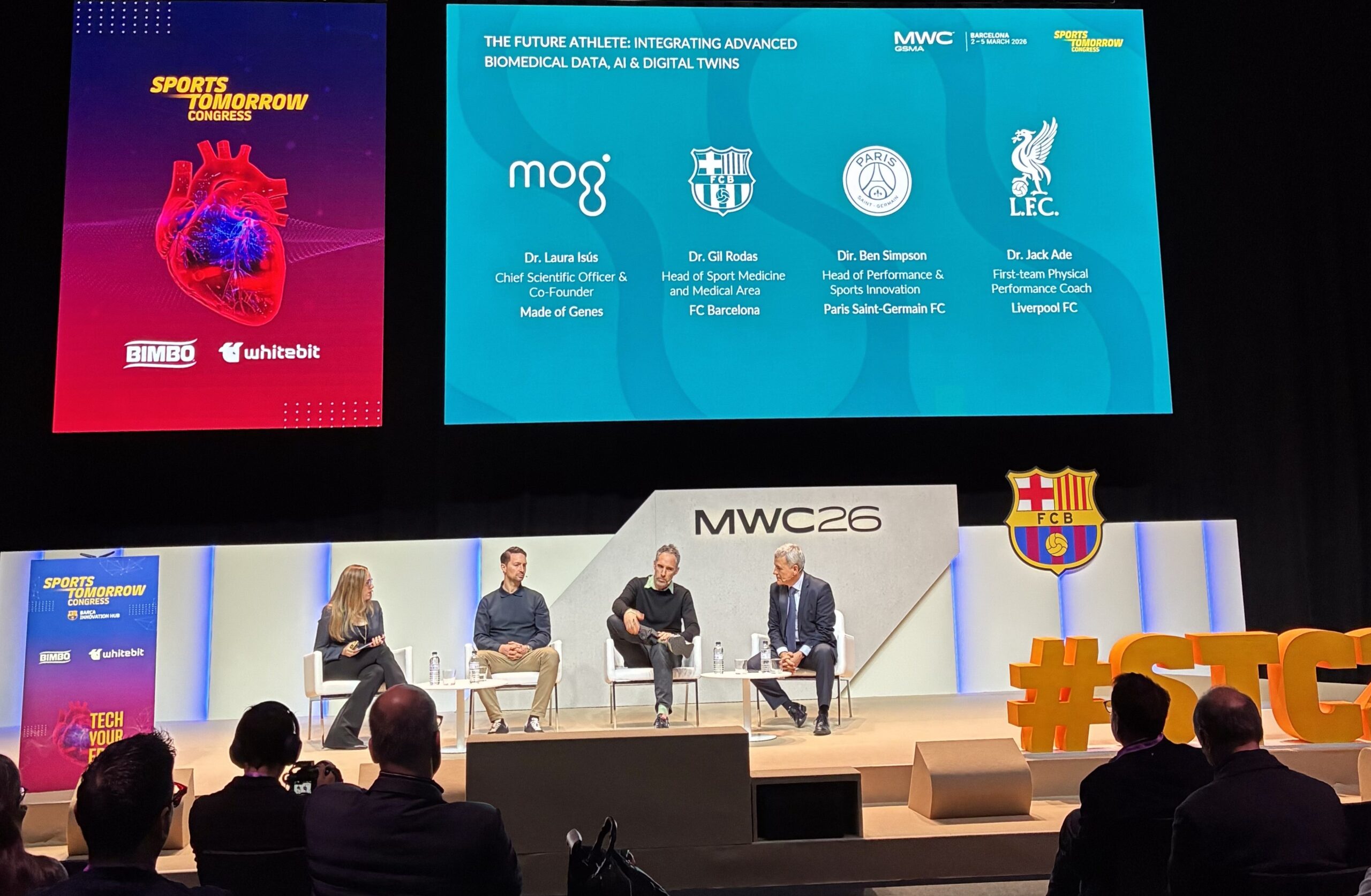
We organized a roundtable about the “future athlete” during the Sports Tomorrow Congress, the innovation sports meeting organized by Barça Innovation Hub and FC Barcelona, during the Mobile World Congress.
Laura Isús, Scientific Director Officer (CFO) of Made of Genes, shared a panel discussion with Dr. Gil Rodas, Head of Sports Medicine at the Barça Innovation Hub and FC Barcelona; Jack Ade, High-Performance Coach for the Liverpool FC first team; and Ben Simpson, Head of Sports Innovation at Paris Saint-Germain FC, concluding that the democratization of access to health data is still pending.
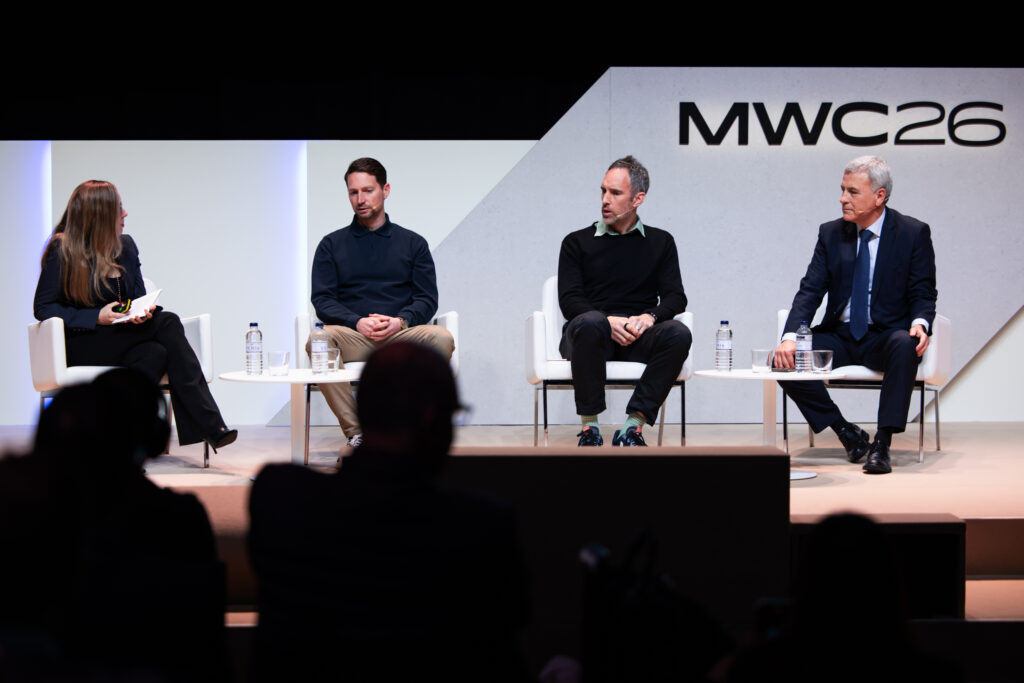
They debated about the main barriers that clubs face in adapting to this new era of health data and how intelligence allows them to move from spreadsheets and clinical reports to a single medical data space that helps improve the performance of each of their players.
For Dr. Gil Rodas, Head of Sports Medicine at the Barça Innovation Hub and FC Barcelona claimed: “Data innovation in the world of sports will be about sharing. Currently, players’ health data is analyzed by the most clinical teams: doctors, physical trainers, physiotherapists, nutritionists… but there is still a way to go for this data to impact coaches’ decisions.”
Health data is typically located in different silos (platforms, data sources), and for it to be understood, a layer of intelligence must be applied to allow everyone to grasp these conclusions. “To achieve this, it’s very important to standardize the language, interpret the data, and make it comprehensible for everyone,” commented Jack Ade, First Team Physical Performance Coach for the Liverpool FC. Furthermore, as Laura Isús stated: “Access to this health data must be highly secure and build confidence within the clubs’ teams. Security and trust are key concepts when talking about the health data of the best soccer players, and the Made of Genes platform makes this possible.”
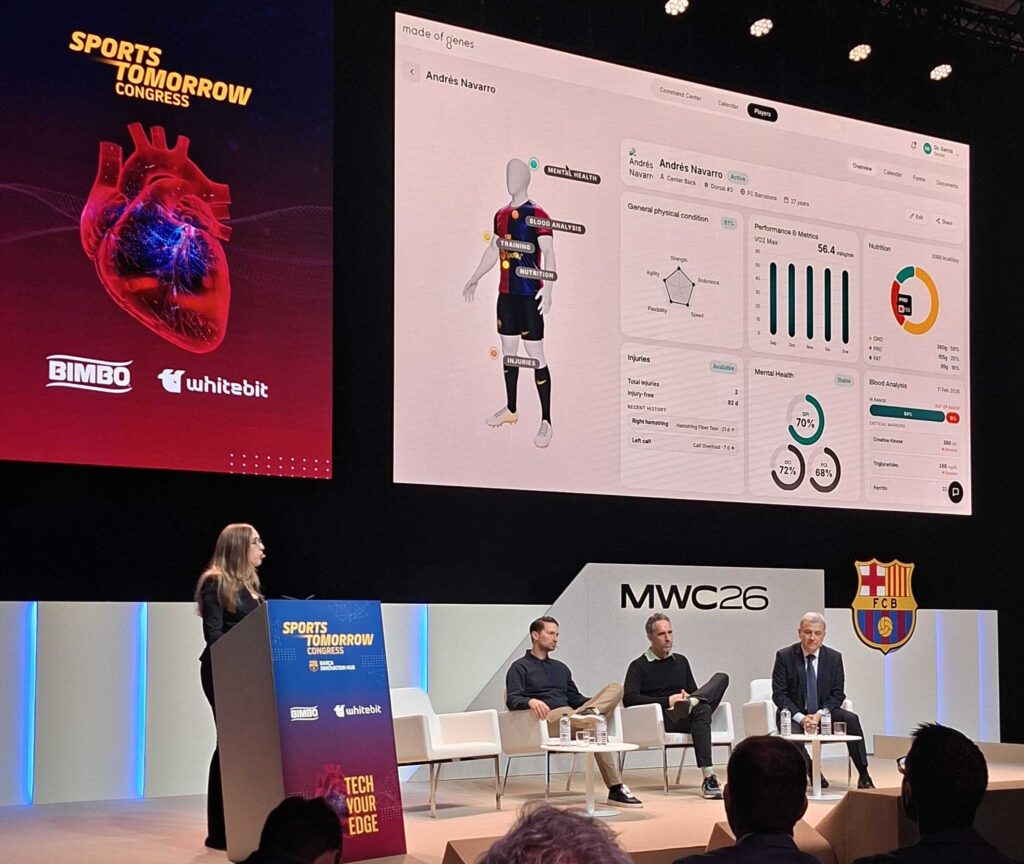
With Made of Genes, the biomedical data collected from players is structured and presented in a much smarter way through the digital twin (Digital Twin or avatar). The tool allows for the analysis of the athlete’s biomedical data (genetics and analytics), but also studies their mental health, other data such as physical status (strength, flexibility, agility, endurance), or data from wearables. Through the Made of Genes platform, one can simulate how the level of training, rest, matches, or travel and transfers on match day affect their performance, and work on injury prediction, improving their endurance, and optimizing the availability of male and female players. This is an important piece of information, as the platform allows for working with gender differences when planning for each athlete.
“In our case, we are working so that this information, which is shown more graphically than an Excel sheet, is easily understood. For this, context is key,” commented Ben Simpson, Head of Sports Innovation at Paris Saint-Germain FC: “Educating the athlete and the technical teams is the way forward,” he concluded.